DAMAGE MULTIPLIERS
Complete Breakdown of All Damage Multiplier Types
Last updated: 2026-04-26
Master every damage multiplier in Arknights: Endfield. Based on the official documentation by 666bj (translated by sten). Covers Base Attack scaling, Critical Hit, Damage Bonus, Damage Reduction, Amplification, Weakness, Sanctuary, Susceptibility, Fragility, Defense, Stagger Frailty, Resistance, Link, Non-Controlled Operator Damage Reduction, and Special Multipliers.
* TL;DR - Key Points
- * All multipliers stack multiplicatively — stack different types for maximum DPS, not the same type
- * Attribute Bonus: Primary × 0.005 + Secondary × 0.002 (integer values only) — primary is 2.5× more valuable than secondary
- * Base CRate 5%, CDMG 50% for operators; enemy CRate is 0%
- * Sanctuary (not "Protection"): only the strongest effect applies — Snowshine and Catcher both give 90%
- * Fragility (not "Increased DMG Taken"): Arts Fragility from Electrification, Physical Fragility from Breach — separate category from Susceptibility
- * Stagger Frailty is 1.3× on all enemies — a separate multiplier from Damage Bonus stagger effects like Perlica's talent
- * Many boss skills apply Non-Controlled Operator Damage Reduction (as low as 0.01×) — expect non-active operators to take far less damage
Contents
Complete Damage Formula
All damage in Arknights: Endfield (except True Damage) follows this multiplicative formula. Each category multiplies against every other category.
Base Total Damage = Base Attack × Critical Hit × Damage Bonus × Damage Reduction × Amplification × Weakness × Sanctuary × Susceptibility × Fragility × Defense × Stagger Frailty × Resistance × Link × Special Multiplier × Non-Controlled Operator Damage Reduction
True Damage bypasses the Defense multiplier. DoT (Damage over Time) bypasses Critical Hit.
1. Base Attack Calculation
Base Attack is the product of the skill's Damage Multiplier and the operator's Attack Power. Unless otherwise specified, all damage in the game is based on Attack Power.
Attack Power Formula
Base Attack = Damage Multiplier × Attack Power
Attack Power = [(OpBaseATK + WeaponATK) × (1 + %Bonus) + FixedBonus] × (1 + AttributeBonus)
- Damage Multiplier: the percentage listed on skill descriptions
- %Bonus: from weapons and equipment traits (additive within this category)
- FixedBonus: flat ATK additions from equipment (may contain hidden decimals)
Attribute Bonus
AttributeBonus = (Primary × 0.005) + (Secondary × 0.002)
Integer portion of attributes only. Displayed values are sufficiently accurate.

INT 624 (primary) → +312.0% ATK

STR 227 (secondary) → +45.4% ATK
- Primary Attribute: 0.5% ATK per point — INT 624 gives +312.0%
- Secondary Attribute: 0.2% ATK per point — STR 227 gives +45.4%
- Combined Attribute Bonus = 357.4% → multiplier of 1 + 3.574 = 4.574×
Worked Example
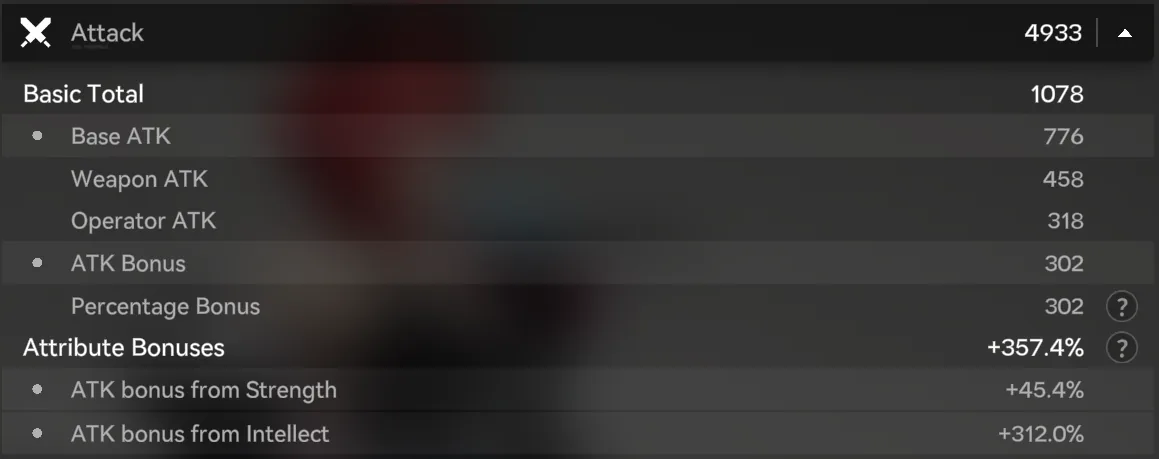
Basic Total (before attr): 776 base + 302.64 bonus = 1,078.64
Attribute Bonus: +357.4% → multiplier 4.574
Final ATK: 1,078.64 × 4.574 = 4,933.7 ≈ 4,933
Note: The displayed "Percentage Bonus" of 302 is actually 302.64 — equipment flat ATK values contain hidden decimals not shown in the panel.
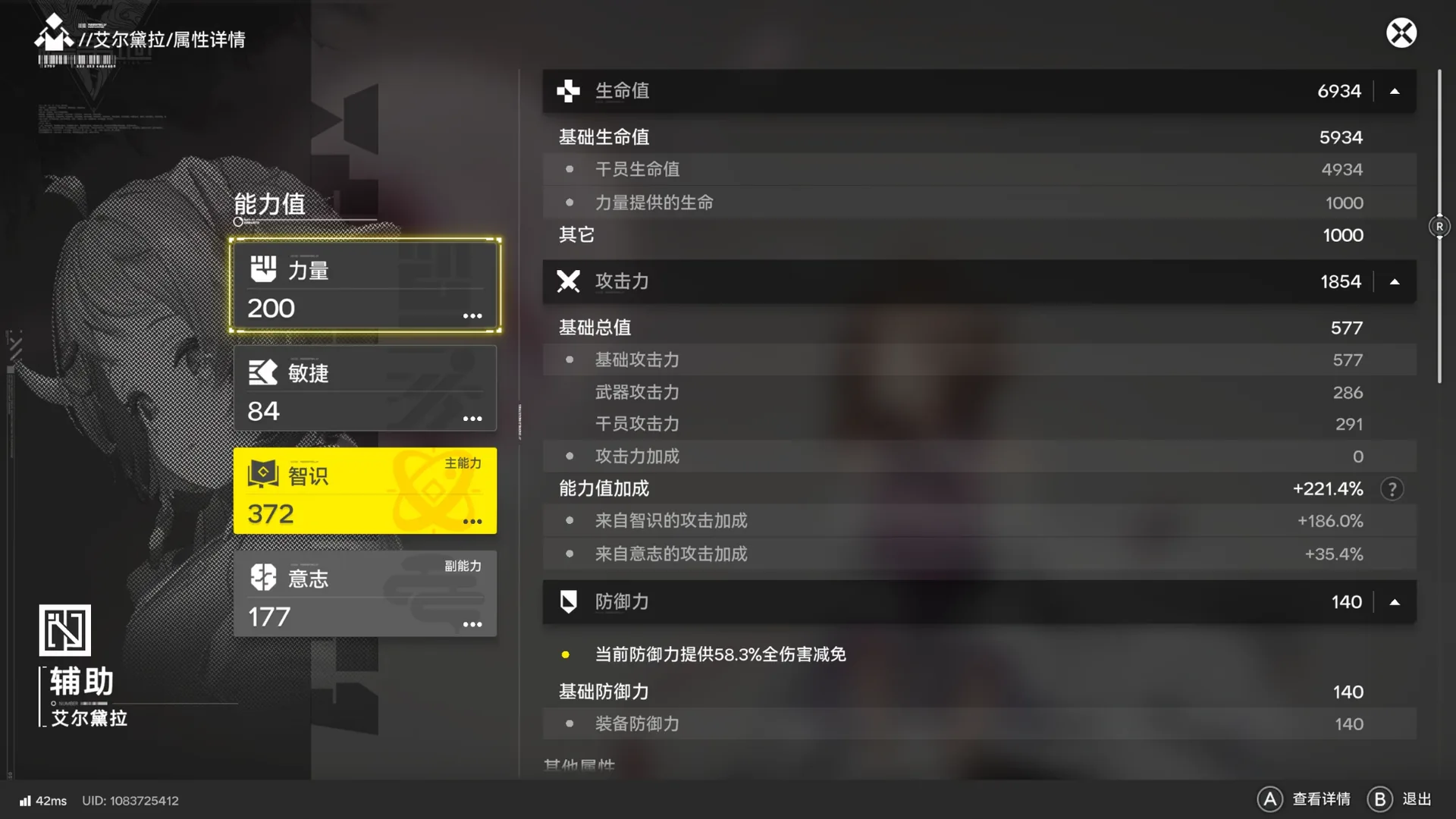
Support operator — INT primary (372), WIL secondary (177)
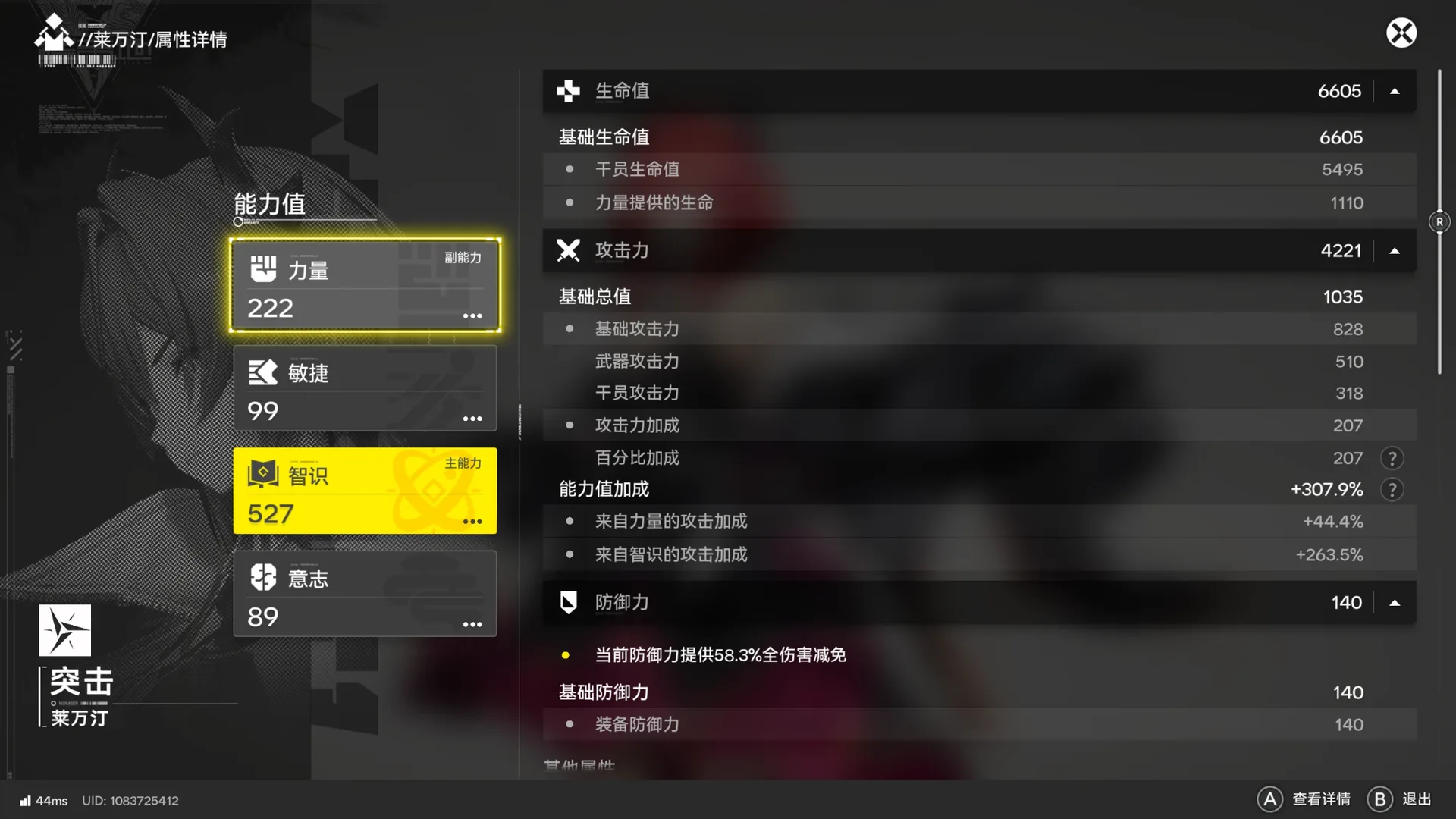
Attack operator — INT primary (527), STR secondary (222)
Base Damage Boost
Some skills add a fixed value on top of the standard formula. Example:
Industrial Explosives: Base Damage = Operator ATK × 120% + 1250
Pro Tip: Primary vs Secondary
Primary attribute is worth 2.5× more than secondary for ATK scaling. Always prioritize your main stat on gear and essences. Some operator talents provide additional attribute bonuses on top of gear.
2. Critical Hit
Critical hits apply CritDMG on top of base damage. Non-critical hits use 1×.
Formulas
On crit: 1 + CritDMG
No crit: 1
Expected crit multiplier: 1 + (CritRate × CritDMG)
| Parameter | Operators | Enemies |
|---|---|---|
| Base CritRate | 5% | 0% |
| Base CritDMG | 50% | 50% |
Note on Crit Building
Critical hit rate can be increased through weapons, equipment, and personal skills. Focus on CRate/CDMG for direct damage dealers; for sustained damage over time effects, prioritize ATK% and Amplification instead.
3. Damage Bonus
All "DMG Bonus" and "DMG Dealt" effects from gear, weapons, and talents add together in this category before multiplying against the rest of the formula.
Formula
Damage Bonus = 100% + Elemental DMG Bonus + Skill DMG Bonus + Stagger DMG Bonus + Other Bonuses
Bonus Sub-Types
- Elemental DMG Bonus: Physical, Heat, Electric, Cryo, Nature, AEther — found as equipment secondary stats (e.g. "Cryo and Electric DMG")
- Skill DMG Bonus: Normal Attacks, Battle Skills, Combo Skills, Finishers — also found as equipment secondary stats
- Stagger DMG Bonus: "Deals more damage to staggered targets" (e.g. Perlica's Talent: +30%). This is additive here — distinct from the separate Stagger Frailty multiplier
- Composite bonuses: Effects combining multiple types, or bonuses with conditional triggers
Important: "All Skill Damage Boost"
"All Skill Damage Boost" only increases Battle Skills, Combo Skills, and Finisher damage — it explicitly excludes Normal Attacks. Plunge attacks and Final Strike still benefit from Normal Attack DMG Bonus specifically.
4. Damage Reduction
Effects that directly decrease incoming damage, targeting specific damage types (All, AEther, Physical, Nature, etc.). Stacks multiplicatively, not additively.
Formula
Damage Reduction = ∏ (1 − each Damage Reduction effect)
Multiplicative Stacking Example
AIC Heavy full set — additive would be: 25.2% total reduction
Actual multiplicative result: 23.0%
Key Examples
- LYNX Connector: 17.15% All Damage Reduction
- Relief Identification Tag: 17.76% All Damage Reduction
- Some dungeons grant Damage Reduction to enemies
- Tidewalker Statue (ranged form): takes +30% Combustion but 50% reduced from all other types — both are in this multiplier category
5. Amplification
Amplification increases the team's damage output for a specific element for a set duration. Distinct from Damage Bonus — do not confuse the two.
Formula
Amplification = 1 + Σ Amplification Effects
Current Sources
- Xaihi: Ultimate Skill
- Antal: Battle Skill and Ultimate Skill
| Element | Affected Damage |
|---|---|
| Heat | Heat damage and Combustion reaction |
| Electric | Electric damage and Electrification reaction |
| Cryo | Cryo damage, Solidification, and Freeze |
| Nature | Nature damage and Corrosion DoT |
Physical Teams: No Amplification
Physical teams have no access to Amplification multipliers. Focus on Susceptibility, Fragility (via Breach), and Stagger Frailty instead. Amplification gear stats on Physical DPS are wasted.
6. Weakness
Weakness reduces the damage dealt by the affected target for a duration. Applies to enemy damage output, not your team's incoming calculation.
Formula
Weakness = ∏ (1 − each Weakness Effect)
Key Notes
- Currently only Catcher's Ultimate provides a Weakness effect
- Stacks multiplicatively — cannot reduce enemy damage to zero
- Situationally valuable for survivability but should not be overrelied upon
7. Sanctuary
Sanctuary reduces all damage taken by the target for a duration, independent of damage type. When multiple Sanctuary effects are active, only the highest value applies.
Formula
Sanctuary = 1 − max(all Sanctuary Effects)
Only the single best Sanctuary effect is used. Stacking multiple sources provides no additional benefit.
Current Sources
- Snowshine: Battle Skill — 90% Sanctuary to the team
- Catcher: Battle Skill — 90% Sanctuary to the team
Running both Snowshine and Catcher together provides no advantage — both cap at 90%, and only one applies at a time. Complete damage immunity is impossible.
8. Susceptibility
Susceptibility increases damage taken from specific attribute types for a duration. Effects in this category are explicitly labeled "Susceptibility" in skill text.
Formula
Susceptibility = 1 + Σ Susceptibility Effects
Current Sources
- Antal: Battle Skill
- Ardelia: Battle Skill
- Gilberta: Ultimate
- Li Feng: Battle Skill
- Estella: Combo Skill
- Last Rite: Talent [Hypothermia]
Last Rite's Talent [Cycle Protocol] only amplifies its specified type of Susceptibility (Cryo Susceptibility) — it does not buff other Susceptibility effects. All Susceptibility effects must be explicitly labeled as such in their descriptions.
9. Fragility
Fragility covers all "increased damage taken" or "take damage +X%" effects that are NOT explicitly labeled "Susceptibility." Remains damage-type dependent. Separate multiplier from Susceptibility — both are valuable to stack.
Formula
Fragility = 1 + Σ Fragility Effects
Current Sources
| Type | Source |
|---|---|
| Arts Fragility | Arts Reaction: Electrification |
| Physical Fragility | Physical Reaction: Breach |
| Cryo Fragility | Xaihi's Talent [Execute Process] |
| Physical Fragility | Endminstrator's Talent [Realspace Stasis] |
Fragility vs Susceptibility
These are two separate multiplicative categories — stack both for maximum effect. When a skill says "Susceptibility" explicitly, it goes into the Susceptibility multiplier. When it says "increased damage taken" or "damage dealt +X%" without the Susceptibility label, it goes into Fragility.
10. Defense
Defense reduces all non-True Damage. Operators start at 0 DEF; enemies have a fixed base of 100 DEF regardless of level.
Defense Formula
True Damage: Defense = 1 (bypassed)
DEF ≥ 0: 100 / (DEF + 100)
Operators have 0 base DEF; enemies have 100 base DEF (fixed, does not scale with level). Default damage reduction: 50% for operator damage vs enemies.
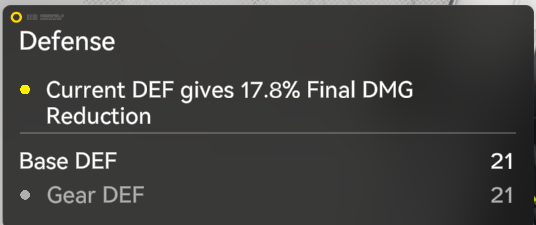
DEF displayed as 21, but actual value is 21.6 → 17.8% reduction
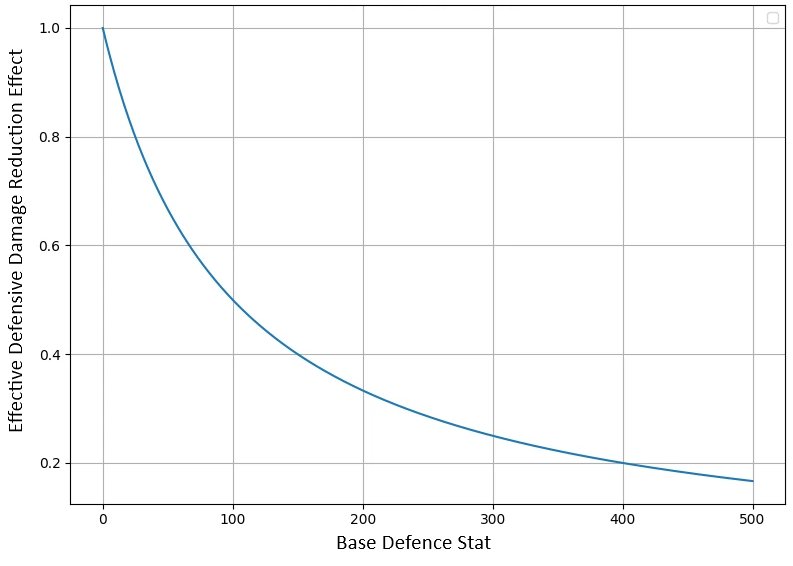
DEF curve — diminishing returns at high values
Key Values
- All enemies: 100 base DEF → 50% damage reduction (0.5× multiplier)
- All operators: 0 base DEF (DEF comes only from gear)
- Breach reduces enemy Physical DEF — can push negative for increased damage
Non-Integer Defense Values
Some equipment pieces have hidden decimal DEF values, causing the displayed formula result to differ from the panel. This only affects level 28 and level 36 gear:
| Gear Level | Slot | Displayed | Actual |
|---|---|---|---|
| Lvl 28 | Armor | 22 | 22.4 |
| Lvl 28 | Glove | 16 | 16.8 |
| Lvl 28 | Kit | 8 | 8.4 |
| Lvl 36 | Armor | 28 | 28.8 |
| Lvl 36 | Glove | 21 | 21.6 |
| Lvl 36 | Kit | 10 | 10.8 |
Example — Lvl 36 Glove displayed as 21:
Using displayed: 21 / 121 = 17.4% reduction (doesn't match panel)
Using actual: 21.6 / 121.6 = 17.76% ≈ 17.8% (matches panel)
Negative DEF Strategy
Breach pushing enemy DEF negative dramatically amplifies Physical damage for the entire team. This is one of the strongest Physical team mechanics.
11. Stagger Frailty
When an enemy enters the staggered state, all damage they take is multiplied by the Stagger Frailty Coefficient. This is a separate multiplier from Damage Bonus stagger effects (like Perlica's talent).
Values
| Condition | Multiplier |
|---|---|
| Target not staggered (or operators) | 1× |
| Target staggered | 1.3× |
All enemies in the current game share this coefficient of 1.3.
What Triggers Stagger
The primary operator accumulates stagger on enemies via:
- Final Strike (last segment of Normal Attack chain)
- Combo Skills
- Battle Skills
- Ultimate Skills
- Certain special effects
Once stagger accumulation reaches the enemy's threshold, the staggered state begins.
Stagger DMG Bonus ≠ Stagger Frailty
Effects like Perlica's "deal 30% more damage to staggered targets" add into the Damage Bonus category (additive). Stagger Frailty (1.3×) is a separate multiplicative layer. You benefit from both simultaneously when hitting a staggered enemy.
12. Resistance
Resistance is measured in points, with each point providing 1% damage reduction against the corresponding element.
Operator Resistance Formula
Physical Resistance Points = 100 − 100 / (0.001 × AGI + 1)
Arts Resistance Points = 100 − 100 / (0.001 × INT + 1)
Integer values of AGI/INT only. Arts Resistance covers all four elements: Cryo, Heat, Nature, Electric.
The resulting resistance multiplier has a minimum floor of 0.1 — it is impossible to stack resistance to full immunity.
Operator Resistance as Damage Multiplier
Resistance Threshold = 1 / (0.001 × AGI/INT + 1)
This is the fraction of incoming damage that passes through. Floor: 0.1 (at extreme values).
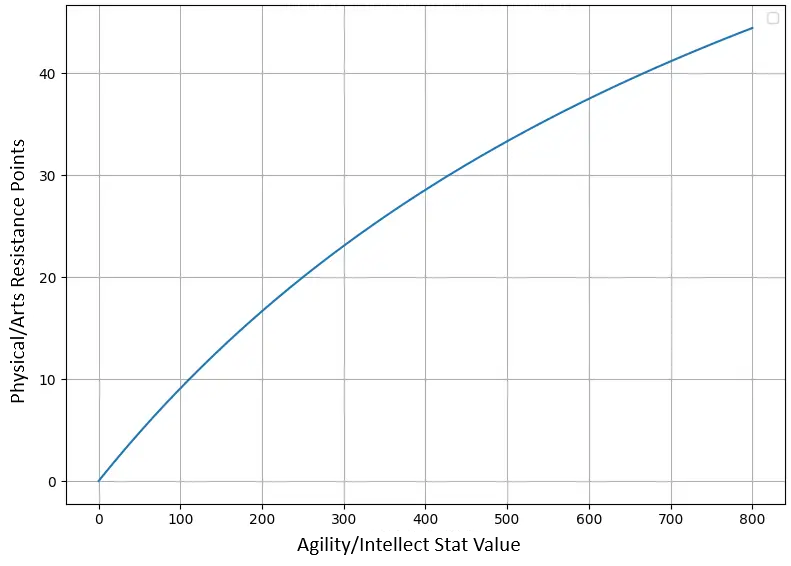
Resistance scales logarithmically — early points are far more valuable than late points
Enemy Resistance Tiers
| Grade | Resistance Points | Damage Multiplier | Notes |
|---|---|---|---|
| D | 0 | 1.0× | Full damage |
| C | 20 (some 30) | 0.8× (or 0.7×) | e.g. Subterranean Beast has 30 pts |
| B | 50 | 0.5× | Bone Crusher Sweeper/Pyromancer (Heat) |
Negative Resistance (Resistance Ignored)
Resistance = 1 − Resistance/100 + IgnoredResistance/100
- Laevatain's Talent [Scorching Heart]: ignores specified Heat resistance points for 20s. Against D-grade (0 pts), this acts as −20 pts → deals 20% more damage
- Corrosion (Nature Reaction): can reduce enemy resistance points
- Both stack — a D-grade enemy can be treated as having negative resistance points
13. Link Multiplier
Link boosts the damage of the team's next Battle Skill or Ultimate. Battle Skills receive a larger bonus than Ultimates. The effect resets upon triggering and stacks up to 4 layers.
Formula
Link Damage Boost = 1 + Link Multiplier (when Link is active)
Stack Values
| Stacks | Battle Skill | Ultimate |
|---|---|---|
| 1 | +30% | +20% |
| 2 | +45% | +30% |
| 3 | +60% | +40% |
| 4 | +75% | +50% |
Current Sources
- Li Feng: Link Skill talent
- Akekuri: Ultimate Skill after unlocking Talent [Staying in the Zone]
- Fluorite's Ultimate self-buff does not apply to the Link multiplier
Link applies to one hit and then resets — best used for high-multiplier burst skills rather than rapid multi-hit abilities. For sustained DPS teams, Susceptibility and Amplification are generally more valuable.
14. Non-Controlled Operator Damage Reduction
Many powerful enemy attacks apply reduced damage to operators not currently being controlled. The vast majority of enemy skills do not trigger this — but certain boss and elite attacks do.
Formula
Most attacks: Non-Controlled coefficient = 1 (full damage to all)
Certain boss skills: coefficient = Non-Controlled Absorption Coefficient
Known coefficient values: 0, 0.01, 0.1, 0.2, 0.3, 0.4, 0.5, 0.7
Enemies With This Mechanic
The following enemies have skills that apply non-controlled damage reduction:
Worked Example: Horned Angel Charge
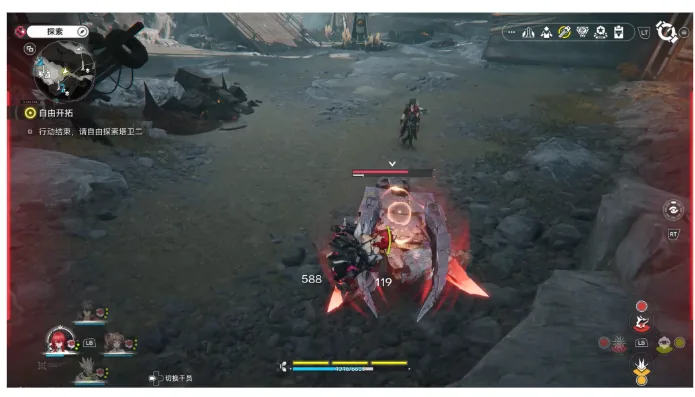
A Level 70 Horned Angel's Charge skill (ATK 3102, 50% multiplier, coefficient 0.2 for non-controlled) hits both Laevatain (primary) and Ardelia simultaneously:
Ardelia — INT 372 (primary), STR 200, WIL 177
Laevatain — INT 527 (primary), STR 222
In-game damage: 588 (primary) vs 119 (non-controlled)
Primary (Laevatain): (3102 × 50%) × (100/240) × (1/1.099) = 588 dmg
Non-controlled (Ardelia): (3102 × 50%) × (100/240) × (1/1.084) × 0.2 = 119 dmg
The 0.2 coefficient reduces Ardelia's damage to about 20% of what she would take as the primary operator.

15. Special Multiplier
Effects that don't fit any other category but operate independently and multiply with all other multipliers. Named "Special Multiplier" in the documentation because no in-game term covers them cleanly.
Bonekrusher Vanguard Shield
Takes 90% reduced damage while its shield is active.
Prism-Connected Enemies
Enemies connected to the Prism enemy take 80% reduced damage.
These effects could conceptually be grouped under Damage Reduction (which also stacks multiplicatively), but they are tracked as a distinct category in the formula.
16. Common Mistakes & How to Avoid Them
1. Stacking Same-Type Multipliers
Focusing all gear on one category (e.g. all Damage Bonus) instead of diversifying. Different multiplier categories multiply together — a balanced spread yields far more DPS.
2. Ignoring Attribute Bonus
Not optimizing your primary attribute — the Attribute Bonus multiplier can exceed 4× at high stat values. Always stack your main attribute on gear and essences. Primary is 2.5× more efficient than secondary.
3. Treating Fragility and Susceptibility as the Same
These are separate multiplier categories — stacking both gives multiplicative gains. Fragility comes from reactions (Electrification, Breach) and talents. Susceptibility is explicitly labeled. Don't ignore either.
4. Neglecting Breach for Physical Teams
Breach generates Physical Fragility and can push enemy DEF negative — both dramatically increase Physical damage for the entire team. Underestimating Breach is one of the largest Physical team optimization mistakes.
5. Forgetting Hidden Decimals
Equipment at Lvl 28/36 has hidden decimal values for ATK and DEF that can cause displayed values to differ from actual calculations. Always account for this when min-maxing.
6. Running Two 90% Sanctuary Operators Together
Snowshine and Catcher both provide 90% Sanctuary — but only the highest value applies. Running both gives zero additional defensive benefit. Choose one and fill the other slot with damage support.
7. Confusing Stagger DMG Bonus with Stagger Frailty
Perlica's "30% more damage to staggered targets" goes into the additive Damage Bonus pool. The 1.3× Stagger Frailty is a separate multiplicative layer. You benefit from both simultaneously when hitting a staggered enemy.
8. Wasting Finishers Outside Stagger Windows
Stagger gives 1.3× — stagger first, then burst. Triggering finishers before staggering the enemy wastes this multiplicative bonus.
9. Over-Investing in Link for Sustained DPS
Link applies to one attack per use. For sustained DPS, Susceptibility and Amplification provide better value than Link stacking.
10. Forgetting Physical Teams Lack Amp
Physical teams should focus on Stagger, Breach, and Susceptibility stacking instead. Amplification gear stats on Physical DPS are wasted.
Quick Reference Checklist
Frequently Asked Questions
How are damage multipliers calculated in Arknights Endfield?
All damage multipliers stack multiplicatively: Base Attack × Critical Hit × Damage Bonus × Damage Reduction × Amplification × Weakness × Sanctuary × Susceptibility × Fragility × Defense × Stagger Frailty × Resistance × Link × Special Multiplier × Non-Controlled Operator Damage Reduction. Stacking different multiplier types is far more effective than stacking the same type.
What is the Attribute Bonus formula and how does it affect damage?
Attribute Bonus = Primary × 0.005 + Secondary × 0.002, using only the integer portion of each stat. Primary attribute grants 0.5% ATK bonus per point, secondary grants 0.2% per point. At INT 624 (primary), you get +312% ATK bonus. Combined with STR 227 (secondary, +45.4%), this gives a 4.574x multiplier on Basic ATK.
How do you maximize Arts damage with Amplification multipliers?
Amplification is provided by Xaihi's Ultimate and Antal's Battle and Ultimate skills. These multiply separately from Damage Bonus. Physical teams cannot use Amplification -- they should focus on Susceptibility, Fragility stacking, and Stagger Frailty instead.
What is the difference between Susceptibility and Fragility?
Both are separate multiplicative damage categories. Susceptibility (1 + Σ effects) is labeled explicitly in skill descriptions. Fragility (1 + Σ effects) covers 'increased damage taken' effects not labeled as Susceptibility -- e.g., Arts Fragility from Electrification, Physical Fragility from Breach, Cryo Fragility from Xaihi's [Execute Process]. Stack both for maximum multiplicative gain.
How does Sanctuary work and does it stack?
Sanctuary reduces all damage taken by a set amount. When multiple Sanctuary effects are active, only the highest value applies -- they do NOT stack. Snowshine and Catcher both provide 90% Sanctuary. Running both together gives no additional benefit; you cannot achieve complete immunity this way.
Sources
Content based on the Endfield Base Damage Documentation by 666bj (original), translated by sten. Companion documents: Reaction Damage Document, Stagger System Document, Additional Numerical Mechanic Document. All game mechanics may change with updates.