BLIGHTSHADE BESTIARY: YINGLUNG PASS THREATS
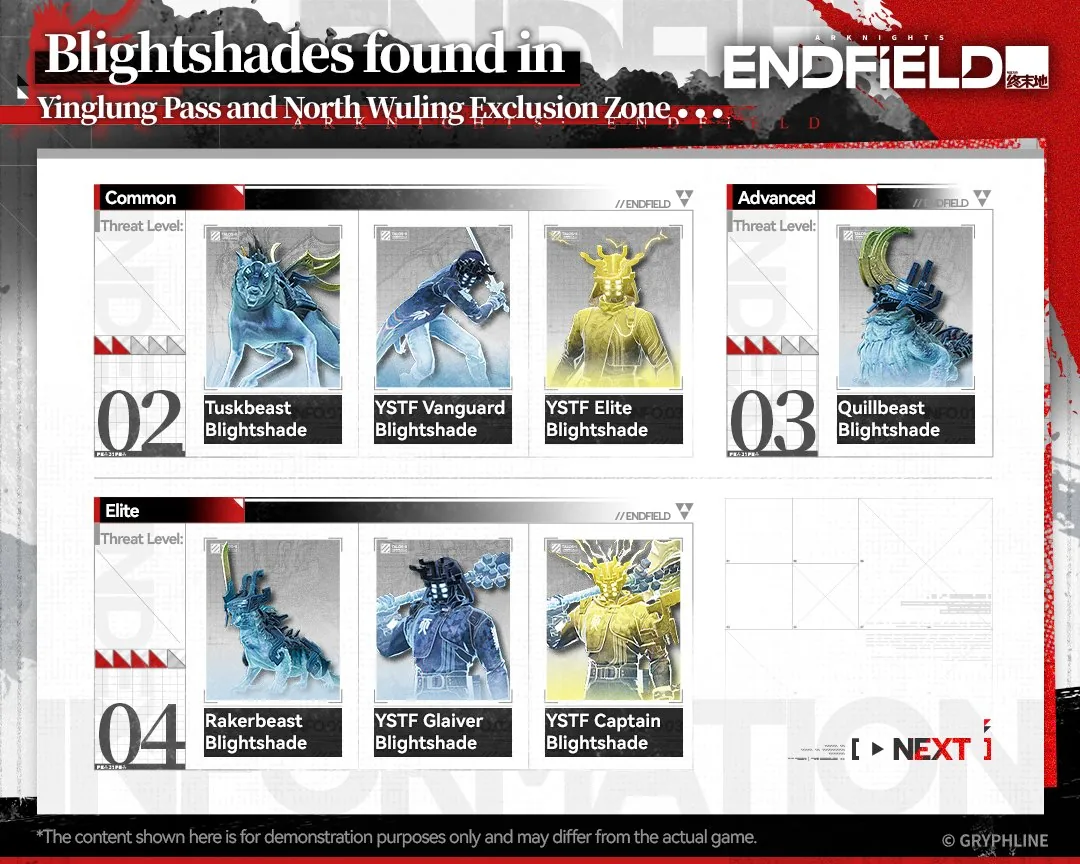
Table of Contents
Version 1.4 does not just hand you two new maps and walk away. Yinglung Pass and the North Wuling Exclusion Zone come stocked with an entirely new enemy family, the Blightshade, and Hypergryph has been drip-feeding threat-profile cards that tell you exactly what you are walking into. These are not reskinned Originium beasts. They are described as “reverberations of the dead,” Æther-replicated shadows that mimic whatever they used to be, and they scale from a harmless Threat Level 02 nuisance up to an UNKNOWN entry the game literally files under “Enemy?” alongside cryptic dialogue from Arcane. This piece walks the full bestiary tier by tier, cross-referenced against the enemy database for stats and resistances, breaks down the Blightshade Energy mechanic you will die to if you ignore it, and closes on the Type 42: Solemn Phalanx, the Arts Unit issued to the same task force that half these enemies used to belong to.
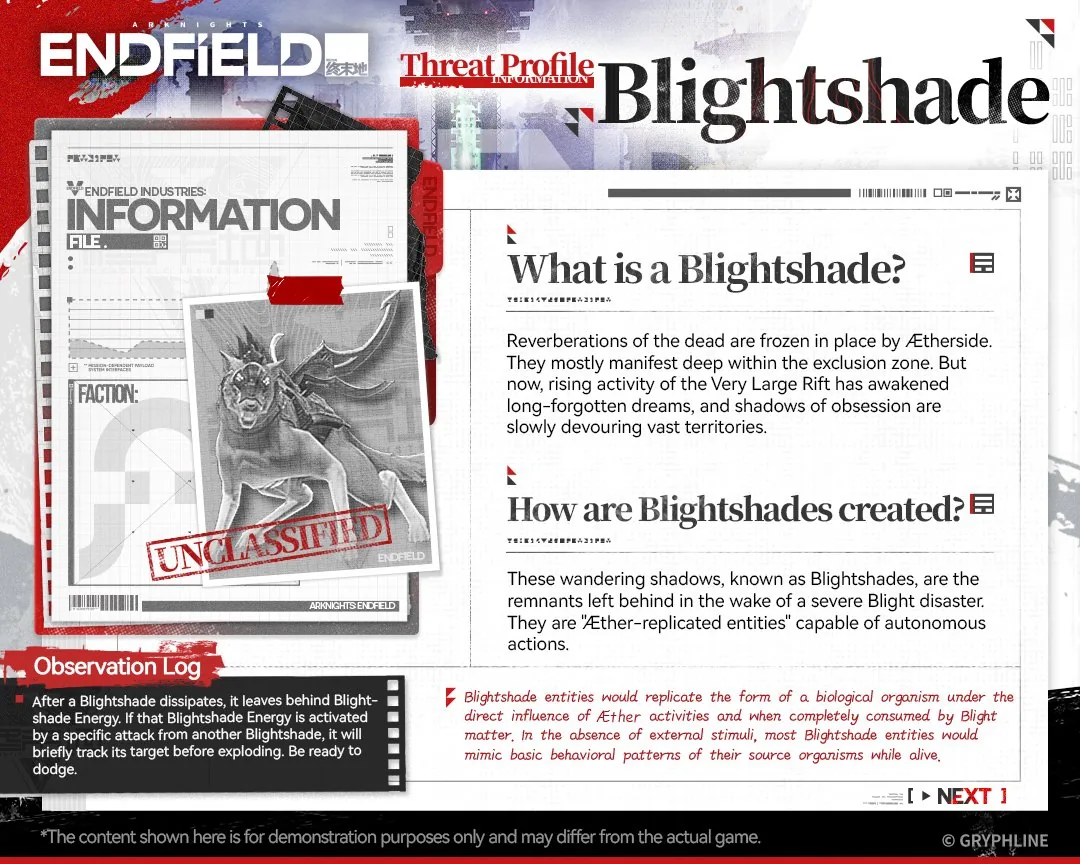
Threat Profile: Blightshade, from the Version 1.4 preview materials. © Gryphline.
TL;DR - Key Points
- Blightshades are Æther-replicated “reverberations of the dead” that manifest deep in the exclusion zone; rising Very Large Rift activity is spreading them across new territory in 1.4.
- They spawn in Yinglung Pass and the North Wuling Exclusion Zone, the same two maps confirmed in the 1.4 Homecoming recap.
- Threat Levels run 02 to 06, from Common (Tuskbeast, YSTF Vanguard, YSTF Elite) up to Alpha (Blitzcrash) and an UNKNOWN “Enemy?” entry, the Enigmatic Pale Blightshade.
- Blightshade Energy is the mechanic to learn first: a dissipated Blightshade leaves energy behind, and another Blightshade’s attack can arm it into a homing bomb that tracks you before it explodes. Dodge on the tell.
- Two enemy archetypes exist: corrupted beasts (Tuskbeast, Quillbeast, Rakerbeast) and corrupted humans, the YSTF (Yinglung Special Task Force) line, Vanguard through Captain.
- Blitzcrash Blightshade (Alpha, 05) was once raised at Tanjian Hall, and Arcane’s dialogue over both Alpha and UNKNOWN entries hints this bestiary is tangled into her story.
- Type 42: Solemn Phalanx is the Arts Unit issued to the YSTF, an Intellect-scaling weapon with an Intellect-versus-Will conditional passive.
- All numbers here are from official preview cards marked “for demonstration purposes” and may shift before the patch goes live.
What Is a Blightshade?
A Blightshade is not an animal, a construct, or a person, even when it looks exactly like one. The threat-profile card defines them as “reverberations of the dead” frozen in place by Ætherside, and they normally manifest deep inside the exclusion zone where most players never travel. What changed for 1.4 is scale. The card is blunt about it: rising activity of the Very Large Rift has “awakened long-forgotten dreams,” and “shadows of obsession are slowly devouring vast territories.” In plainer terms, the Rift is pushing harder, and the Blightshade footprint is expanding into ground you actually have to walk through.
That framing matters for how you read the rest of this bestiary. Blightshades are an environmental symptom of the Rift, not a faction with goals. They do not raid, they do not coordinate across a map, and they do not want anything. They are what is left over when Æther saturates a place and starts replaying the shapes of whatever died there. If you have been following the Yinglung Pass zone tour, this is the other side of the Exclusion Gate that the pass exists to hold shut.
How Blightshades Are Created
The second half of the profile card explains the mechanism, and it is grim in a way that recontextualizes every enemy name on the list. Blightshades are “the remnants left behind in the wake of a severe Blight disaster.” They are called “Æther-replicated entities” that are capable of autonomous action, which is why they can chase and attack you rather than just standing there like scenery.
The key sentence is the handwritten note at the bottom of the card: a Blightshade entity replicates the form of a biological organism under the direct influence of Æther activity, specifically when that organism is completely consumed by Blight matter. In the absence of external stimuli, most Blightshades will mimic the basic behavioral patterns of their source organism while it was alive.
Read that twice, because it tells you two useful things. First, a Blightshade behaves like the thing it copied, so a copied soldier fights like a soldier and a copied beast fights like a beast. Second, and this is the part that stings, every “YSTF” Blightshade on the roster used to be a living member of the Yinglung Special Task Force before Blight matter took them. The enemies you fight in the pass are, in-universe, the garrison that was supposed to be holding it.
Blightshade Energy: The Delayed Explosion
If you learn one mechanic before setting foot in Yinglung Pass, make it this one. The Observation Log on the profile card describes it directly: after a Blightshade dissipates, it leaves behind Blightshade Energy. On its own, that residue is inert. The danger is the trigger. If that leftover energy is activated by a specific attack from another Blightshade, it will briefly track its target and then explode.
The card’s advice is a single instruction: be ready to dodge.
Here is why that is more than flavor text. In a pack fight, killing one Blightshade does not clear its threat, it plants it. The energy sits on the ground until a surviving Blightshade’s attack arms it, at which point it becomes a short-lived homing bomb aimed at whoever it locks onto, usually you. That creates a rhythm most new enemy types do not have: the most dangerous moment in a Blightshade fight is often a second or two after you score a kill, not during the kill itself.
Practically, that means you should not stand on top of corpses, you should keep moving through the back half of a pack fight, and you should treat any Blightshade attack animation as a potential detonator rather than just an incoming hit. Positional players who already kite will barely notice this. Players who stand and trade will eat a lot of avoidable explosions until the habit sinks in.
Threat Levels at a Glance
The bestiary sorts every Blightshade into a labeled tier with a numeric Threat Level. The tiers are not just difficulty flavor, they map onto the enemy’s role and how much attention it demands. Here is the full spread from the preview cards.
| Tier | Threat Level | Blightshades | What to expect |
|---|---|---|---|
| Common | 02 | Tuskbeast, YSTF Vanguard, YSTF Elite | Trash and fodder; fought in packs |
| Advanced | 03 | Quillbeast | Ranged or zoning pressure |
| Elite | 04 | Rakerbeast, YSTF Glaiver, YSTF Captain | Mini-boss pressure; priority kills |
| Alpha | 05 | Blitzcrash Blightshade | Named threat with a warning banner |
| Enemy? | UNKNOWN (06) | Enigmatic Pale Blightshade | Story-flagged unknown, tied to Arcane |
Two things stand out. The Common tier already mixes beasts and humans, so you never get a “just beasts” or “just soldiers” warm-up. And the ladder ends on a deliberately blank entry, an unnumbered UNKNOWN threat the game refuses to classify, which is a storytelling choice as much as a combat one.
Common Blightshades (Threat Level 02)
The Common tier is your day-to-day fodder in the pass, and it is where you will meet both enemy archetypes side by side. Three show up here.
- Tuskbeast Blightshade is the corrupted-beast entry, a four-legged charger built to close distance and body you. Treat it like the melee beast it used to be.
- YSTF Vanguard Blightshade is a corrupted front-line soldier of the Yinglung Special Task Force, the baseline human melee unit.
- YSTF Elite Blightshade is a step up in the same line, a heavier soldier silhouette that hits harder and soaks more.
Common, Advanced, and Elite Blightshades found across Yinglung Pass and the North Wuling Exclusion Zone. © Gryphline.
None of these should be scary in isolation. The catch is that they almost never appear in isolation, and every one of them that dies feeds the Blightshade Energy problem from the previous section. In a mixed pack, the Vanguards and Tuskbeasts are the bodies you clear first, but their leftover energy is exactly what a surviving Elite can arm into an explosion. Clear efficiently, keep moving, and do not let a “trivial” Common pack turn into a minefield.
Advanced and Elite Blightshades (Threat Levels 03 to 04)
Above the Common tier the roster splits cleanly into one Advanced enemy and a three-strong Elite bracket, and the beast-versus-human pattern keeps holding.
Quillbeast Blightshade is the lone Advanced (03) entry. The name and silhouette point to a ranged or quill-throwing beast, the kind of enemy that pressures you from distance and punishes players who only think about melee threats. Close the gap or break line of sight; do not stand in the open trading ranged hits.
The Elite (04) bracket is where fights start to feel like mini-bosses:
- Rakerbeast Blightshade is the corrupted-beast Elite, a larger, meaner counterpart to the Tuskbeast with more health and more dangerous swings.
- YSTF Glaiver Blightshade is a polearm soldier, a reach-heavy human Elite that controls space with long, telegraphed sweeps.
- YSTF Captain Blightshade is the top of the human line, an officer-tier unit that reads as the most dangerous non-named enemy in the pass.
| Blightshade | Origin | Role | Priority |
|---|---|---|---|
| Quillbeast | Beast | Ranged / zoner | Close distance early |
| Rakerbeast | Beast | Heavy melee | Kite, punish recovery |
| YSTF Glaiver | Human (YSTF) | Reach melee | Respect the sweep range |
| YSTF Captain | Human (YSTF) | Officer / elite | Kill first in a pack |
The rule of thumb for this bracket: in any mixed group, the YSTF Captain is your first kill, because an officer-tier unit left alive is exactly the kind of enemy whose attacks arm Blightshade Energy on everything you have already downed.
Alpha Threat: Blitzcrash Blightshade (Threat Level 05)
The Alpha tier gets its own red WARNING banner, and only one enemy sits in it: the Blitzcrash Blightshade. Its info card is the first place the bestiary stops being a catalog and starts being a story.
The description is short and pointed. The beast “was once raised at Tanjian Hall and shared a past with someone. Its Blightshade, however, retains nothing but its instincts for aggression.” That is the mechanism from earlier stated as tragedy: whatever this creature was, and whoever it mattered to, the Blight kept only the violence. As an Alpha threat it is a named, single-target fight rather than pack fodder, so expect a real health pool, real telegraphs, and enough uptime that the Blightshade Energy dodge becomes a sustained discipline instead of an occasional reaction.
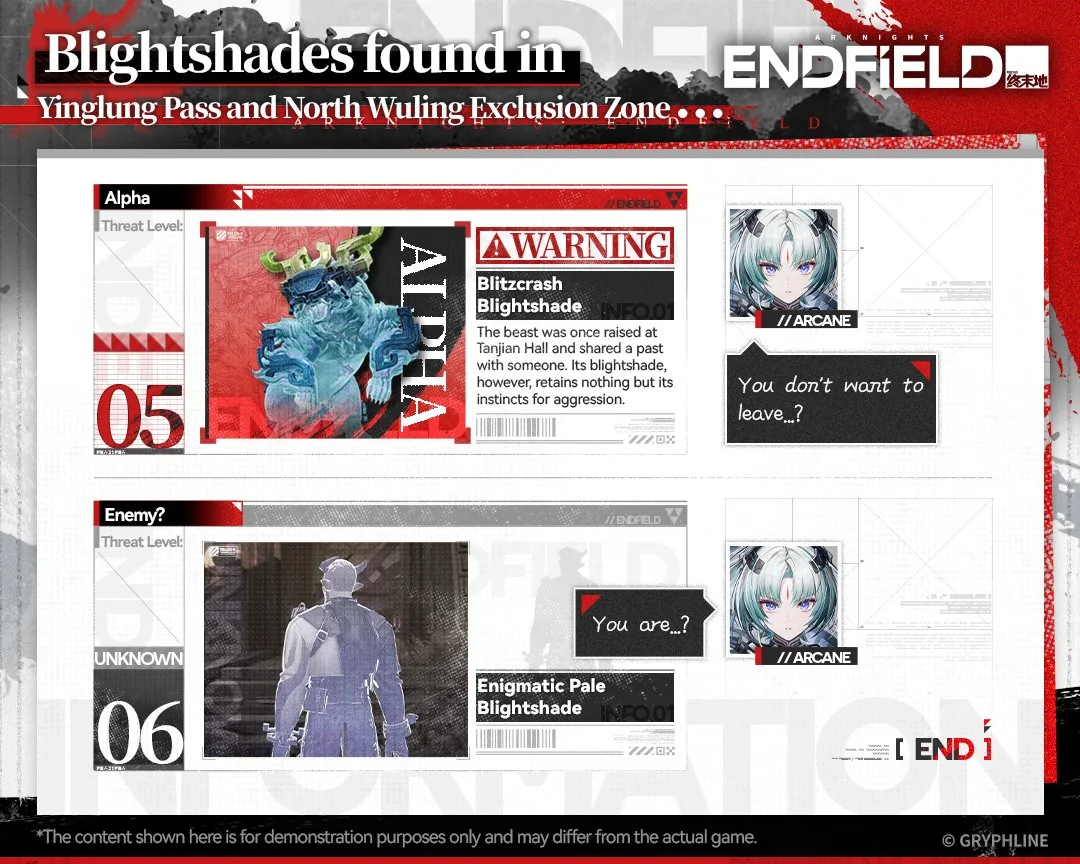
The Alpha threat Blitzcrash Blightshade and the UNKNOWN Enigmatic Pale Blightshade, both overlaid with Arcane’s dialogue. © Gryphline.
The detail that turns heads is the dialogue box floating over the card, attributed to Arcane: “You don’t want to leave…?” It is not narration, it is a character speaking, and it is attached to an enemy with a shared past. If you have read our Li Zhiyan (Arcane) story profile, the implication is hard to miss: this bestiary is not a neutral field guide, it is threaded into Arcane’s arc, and Blitzcrash is very likely a story beat wearing an Alpha threat’s clothes.
The Enigmatic Pale Blightshade (Threat Level UNKNOWN)
Then the ladder breaks. The final entry is not labeled with a tier name at all; it is filed under “Enemy?” with a threat level of UNKNOWN (06), and its card shows a human silhouette from behind rather than a monster render. Its name is the Enigmatic Pale Blightshade.
Everything about the presentation is a deliberate question mark. Where every other card commits to a classification, this one refuses. Where every other render shows you the threat head-on, this one shows a figure walking away. And once again there is an Arcane dialogue box, this time reading “You are…?” The pairing of a pale, human-shaped “enemy?” with Arcane asking who it is reads less like a combat encounter and more like a reveal the patch is holding back.
We are not going to pretend to know who this is, because the card is engineered specifically to stop you from knowing. What we can say is structural: the bestiary intentionally ends on an unclassifiable, human-shaped entity that Arcane does not recognize, and that is the kind of setup Endfield uses when a “monster of the week” list is actually seeding a longer story. Whether the Enigmatic Pale Blightshade is a boss, an ally, or a twist tied to Arcane’s past is exactly the thread 1.4’s main story looks built to pull.
The YSTF Connection: Type 42 Solemn Phalanx
Half the Blightshade roster carries the YSTF tag, the Yinglung Special Task Force, and the weapon materials give that acronym a face. The Type 42: Solemn Phalanx is an Arts Unit designed and developed by the Hongshan Swordmancers, and its own card says it is “currently issued to members of the Yinglung Special Task Force.” The same soldiers whose corrupted echoes you fight in the pass carried this exact weapon in life. That is not subtle, and it is a large part of why the enemy list and the weapon shipped together.
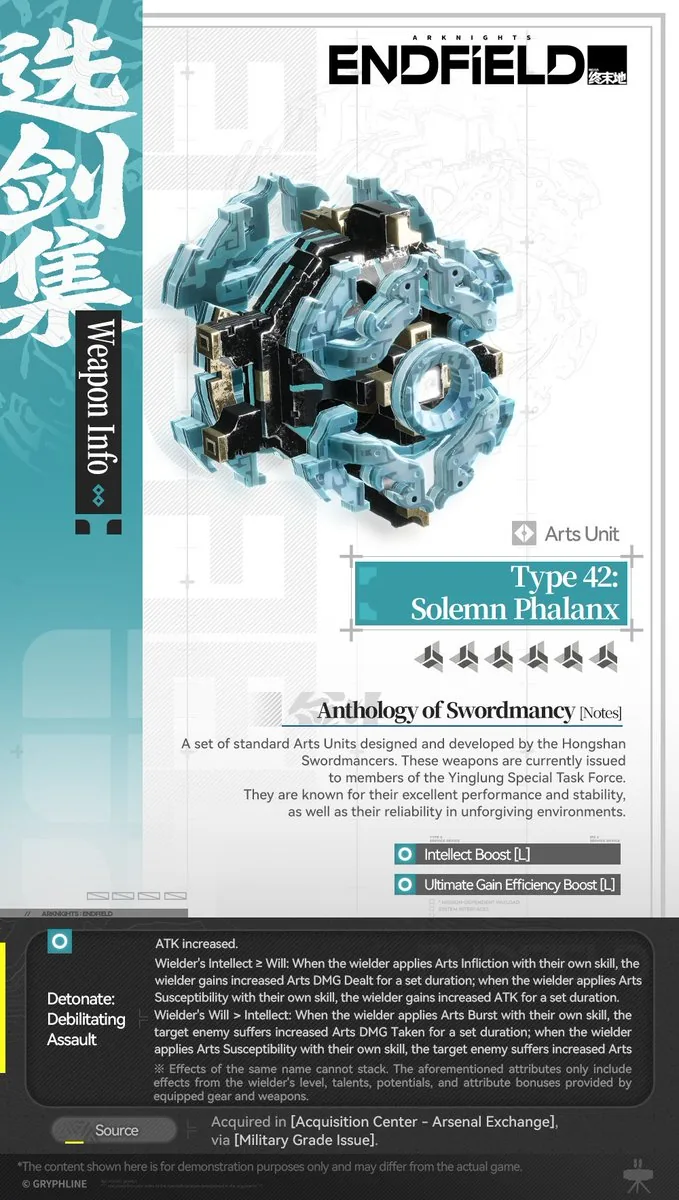
Weapon Info: Type 42 Solemn Phalanx, the Arts Unit issued to the YSTF. © Gryphline.
Mechanically, Solemn Phalanx is an Intellect-scaling Arts Unit. Its listed stats are an Intellect Boost [L] main line and an Ultimate Gain Efficiency Boost [L] substat, so it is a weapon for casters who want fast ultimate cycling. The interesting part is the signature passive, Detonate: Debilitating Assault, which raises ATK and then branches on your stat spread:
- When Intellect is greater than or equal to Will: applying Arts Infliction with your own skill grants increased Arts DMG Dealt for a duration, and applying Arts Susceptibility with your own skill grants increased ATK for a duration. This is the self-buff, DPS-leaning branch.
- When Will is greater than Intellect: applying Arts Burst with your own skill makes the target enemy take increased Arts DMG for a duration, and applying Arts Susceptibility makes the target take increased Arts DMG. This is the enemy-debuff, support-leaning branch.
In other words, the weapon reshapes itself around whether you build the holder as a damage dealer or an enabler, which is a natural fit for operators who care about the Intellect-versus-Will axis. It comes from the Acquisition Center - Arsenal Exchange via Military Grade Issue. For where it slots against the rest of the Arts Unit pool, our arsenal weapon meta breakdown ranks the category, and the Arcane build guide covers how an Intellect-scaling Arts Unit plays in practice.
How to Prep by Player Type
Not everyone reads a bestiary for the same reason, so here is what actually matters depending on how you play.
- Story-first players: you can mostly ignore the tier table and focus on the Blitzcrash and Enigmatic Pale entries. Those two are where the Arcane thread lives, and they are the fights the narrative is built around. Everything else is set dressing for the pass.
- Combat and clear-speed players: internalize the Blightshade Energy dodge before anything else, then learn the Elite bracket’s kill order (YSTF Captain first). The pass is a mixed-pack environment, so AoE and mobility matter more than single-target burst against the Common tier.
- Collectors and completionists: the roster is small enough (eight named entries) to fully log, and the YSTF-versus-beast split means you are hunting two visually distinct families. The UNKNOWN entry is the one worth watching, since a story-flagged “Enemy?” often resolves into something more than a standard bestiary tick.
Common Mistakes vs Blightshades
The Blightshade family punishes a specific set of bad habits. Watch for these.
- Standing on your own kills. Blightshade Energy pools where enemies die. Camping that spot in an active fight is how you get armed and detonated. Move through, do not root.
- Treating every Blightshade attack as just damage. Any surviving Blightshade’s swing can be the trigger that arms leftover energy. The dangerous animation is not always aimed at you directly.
- Ignoring the ranged Quillbeast. It is only Advanced (03), so players tunnel the scarier-looking Elites and eat chip damage from range the whole fight. Close it down early.
- Leaving the YSTF Captain alive “for last.” Officer-tier units are exactly the enemies whose attacks arm your downed fodder. Kill the Captain first, not last.
- Reading the bestiary as pure combat. The Blitzcrash and Enigmatic Pale cards carry Arcane dialogue for a reason. If you blitz past them for loot, you are skipping the point of the zone.
What Would Change This
Everything above comes from official preview cards stamped “for demonstration purposes only and may differ from the actual game,” so treat exact behaviors as provisional until the patch is live. A few specific things are worth watching:
- CN and test-server data. Concrete numbers, health pools, damage values, and the precise timing of the Blightshade Energy detonation, will surface from datamines and early servers first. Historically those beat English wikis by days.
- The Alleikhreos boss. The 1.4 Homecoming recap names a separate new boss, Alleikhreos, Chiliarch. He turned out to be a distinct threat, the first of a brand new “Foundite” enemy class rather than a Blightshade, as our Alleikhreos, Chiliarch boss intel report breaks down in full.
- The Enigmatic Pale reveal. If the UNKNOWN entry resolves into a story character or a hidden boss, this bestiary’s whole shape changes. That is the single biggest open variable in the list.
- Solemn Phalanx tuning. Weapon passives frequently get numeric adjustments between preview and launch. The Intellect-versus-Will branching structure is likely stable; the magnitudes are not.
Final Read
The Blightshade family is a smart piece of design because the combat hook and the story hook are the same hook. Mechanically, Blightshade Energy turns every kill into a positioning puzzle, which keeps even Common packs honest and rewards the players who already move well. Narratively, the “reverberations of the dead” framing means every YSTF enemy is a soldier the pass failed to save, and the ladder deliberately climbs from that quiet tragedy up to Blitzcrash’s shared past and an UNKNOWN entry Arcane cannot name. It would have been easy to ship a flat list of exclusion-zone monsters. Instead 1.4 shipped a bestiary that is clearly load-bearing for Arcane’s story. Log the roster, learn the dodge, and pay attention to the two cards that talk back.
Frequently Asked Questions
What is a Blightshade in Arknights: Endfield? A Blightshade is an Æther-replicated “reverberation of the dead,” an autonomous shadow-entity created when a biological organism is completely consumed by Blight matter. It mimics the form and basic behavior of whatever it used to be. Blightshades are the new enemy family introduced in Version 1.4.
Where do Blightshades appear? They manifest deep in the exclusion zone and, as of 1.4, across the two new maps: Yinglung Pass and the North Wuling Exclusion Zone. Rising Very Large Rift activity is what pushes them into that new territory.
What is Blightshade Energy? It is the residue a Blightshade leaves behind after it dissipates. On its own it is inert, but if another Blightshade’s attack activates it, the energy briefly tracks a target and then explodes. The counterplay is to dodge on the tell and avoid standing on your own kills.
How many Blightshades are there? The preview bestiary lists eight named entries across five tiers: Tuskbeast, YSTF Vanguard, YSTF Elite (Common 02), Quillbeast (Advanced 03), Rakerbeast, YSTF Glaiver, YSTF Captain (Elite 04), Blitzcrash (Alpha 05), and the Enigmatic Pale Blightshade (UNKNOWN 06).
What does “YSTF” mean? YSTF is the Yinglung Special Task Force, the unit stationed at the pass. The YSTF-tagged Blightshades are corrupted echoes of its soldiers, and the Type 42 Solemn Phalanx is the Arts Unit issued to that same force.
Who is the Blitzcrash Blightshade? Blitzcrash is the sole Alpha (Threat Level 05) enemy, a beast once raised at Tanjian Hall that “shared a past with someone.” Its Blightshade retains only aggression. Arcane’s dialogue over its card (“You don’t want to leave…?”) suggests it is tied to her story.
What is the Enigmatic Pale Blightshade? It is the bestiary’s final entry, filed as “Enemy?” with an UNKNOWN threat level. Its card shows a human silhouette from behind and carries Arcane asking “You are…?” It is deliberately left unclassified, strongly implying a story reveal rather than a standard combat encounter.
Is the Type 42 Solemn Phalanx worth pulling? It is an Intellect-scaling Arts Unit with Ultimate Gain Efficiency and a passive that branches between a self-DPS mode (Intellect >= Will) and an enemy-debuff mode (Will > Intellect). It suits Intellect-focused casters. For where it lands in the Arts Unit tier order, see our arsenal weapon meta breakdown.
Are these numbers final? No. All of this comes from official preview cards labeled “for demonstration purposes only and may differ from the actual game.” Behaviors, tiers, and the Solemn Phalanx passive values can change before Version 1.4 goes live. Check back as CN and test-server data confirms the specifics.

Tap through for today's price on the official store. Affiliate link, we may earn a commission.
Take a Break
Available on desktop