ELASTIC GOODS TRADING GUIDE: PRICE PEAKS & WEEKLY STRATEGY
Table of Contents
Elastic Goods is the most overlooked income lane in the entire Talos-II outpost economy. The system sits behind the Lucky Carrot terminal in Valley IV, opens up at Authority Level 14, and rewards five minutes of price-checking with daily profits that easily clear 80,000 Stock Bills once you understand how the weekly cycle works. Most pioneers either ignore the system entirely or chase the wrong number on every screen, leaving a meaningful chunk of Stock Bills on the table week after week.
This guide covers all 18 Elastic Goods items split across the Valley IV and Wuling regions, the three price tiers that govern every item's selling ceiling, the buy-low-sell-high cycle that runs from Monday through Sunday, the friend-terminal flow that beats the open market on margin, and the realistic discount targets that keep your trading routine fast instead of obsessive. The numbers, item lists, and tier breakdowns come from in-game testing and the community-maintained Elastic Goods spreadsheet, and they are tuned for the current patch, launch-era ceilings of 5,600 to 6,000 bills no longer apply.
What you get out of reading this is a five-minute daily routine that converts your stock allocations into Stock Bills you can actually use, funding terminal upgrades, financing your Wuling Stock Bill stockpile, and feeding the broader outpost economy that underpins gear crafting and progression. The strategy is not complicated, but the discipline is real: knowing your tier, refusing to chase percentages, and waiting for the right day of the week to sell.
This article does not cover the Staple Goods system or the Stock Redistribution mission chain that gates the terminals themselves. Both have their own dedicated guides. It also does not cover one-off event promotions or the temporary discount events that occasionally collide with the weekly cycle. Treat the numbers below as the steady-state economy, and adjust around event modifiers as they appear.
Quick Answer
Buy Elastic Goods on Monday when prices bottom out, hold them until Thursday through Sunday when the market peaks, and check friend shops before the open market every single time. The base cost of every item is 2,000 Stock Bills, so a realistic buy target is anything around 1,000 to 1,100 bills (a 40 to 50 percent discount) and a realistic sell target is whatever your item's price tier caps at, 4,600 to 4,700 for Low Peak, 5,000 to 5,100 for Mid Peak, and 5,400 to 5,500 for High Peak. Wuling-region goods consistently peak roughly 100 bills higher than their Valley IV equivalents.
Operate on raw bill numbers, never percentages. Profit equals sell price minus buy price, and that is the only figure that matters when deciding what to clear from your shop or what to scoop up from a friend's. Stock allocations stack for two to three days, so skipping a bad-discount day costs you nothing and waiting for max discounts (the rare ~-85% offers below 400 bills) costs you everything.
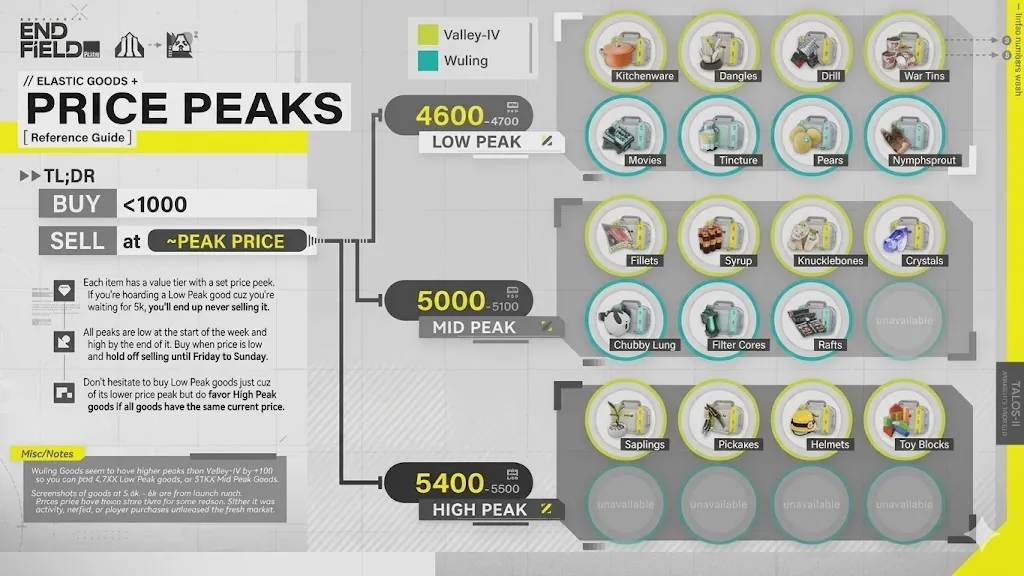
The reference image above shows every Elastic Good binned into the three peak tiers. Memorising which bucket each item lives in is the single most useful piece of work in this entire system, once you know that a Drill caps at 4,700 and a Pickaxe caps at 5,500, you stop accidentally holding Low Peak items for prices they will never hit, and you stop selling Wuling High Peak items at Valley IV prices.
Price Tiers Breakdown
Every Elastic Good in the game shares the same base cost of 2,000 Stock Bills, and the market then flexes that base up or down across the week. What separates the items is not the base, the discount curve, or the buy-side mechanics. It is the maximum price the market is willing to pay on a peak day. That maximum is hard-locked into three tiers, and the tier never changes for a given item.
Low Peak items cap at 4,600 to 4,700 bills and cover the eight Valley IV staples, Kitchenware, Dangles, Drill, War Tins, Movies, Tincture, Pears, and Nymphsprout. Mid Peak items cap at 5,000 to 5,100 and cover Fillets, Syrup, Knucklebones, Crystals, Chubby Lung, and Filter Cores in Valley IV, plus Rafts in Wuling. High Peak items cap at 5,400 to 5,500 and are dominated by the four Wuling-only goods, Saplings, Pickaxes, Helmets, and Toy Blocks. Knowing which slot every item lives in is what stops you waiting for a 5k sell on a Drill that will never get there.
The practical rule that falls out of this is simple: do not chase the tier ceiling. If you are hoarding a Low Peak good waiting for a 5,000 bill sell offer, you will end up never selling it. Each item works inside its own range, and the right move is to sell into the upper third of that range the moment a buyer is offering it, not to wait for a number from a higher tier that the system will never print on that item.
| Tier | Peak Price | Region & Items |
|---|---|---|
| Low Peak | 4,600 – 4,700 | Valley IV: Kitchenware, Dangles, Drill, War Tins, Movies, Tincture, Pears, Nymphsprout |
| Mid Peak | 5,000 – 5,100 | Valley IV: Fillets, Syrup, Knucklebones, Crystals, Chubby Lung, Filter Cores · Wuling: Rafts |
| High Peak | 5,400 – 5,500 | Wuling: Saplings, Pickaxes, Helmets, Toy Blocks |
Two things follow from this table that you should bake into your buying decisions. First, when several items are sitting at the same current price on a given day, favour the High Peak goods, same outlay, higher ceiling later. Second, Wuling goods consistently peak about 100 bills higher than their Valley IV counterparts, but max discounts on Wuling-tier goods may only start appearing once you have unlocked all the Wuling outposts. Until that happens, your discount opportunities will skew toward Valley IV items, which is fine, Mid Peak Valley IV goods still print real profit.
Weekly Price Cycle
Elastic Goods prices follow a predictable weekly arc, and the entire trading strategy rests on knowing which day of the week is a buy day and which is a sell day. The market starts each week soft, drifts up through Wednesday, and prints its highest peaks in the back half of the week. Trading against this cycle, buying on a high day or selling on a low day, will halve your profit even if every other number is perfect.
Monday is the buy day. Start-of-week prices bottom out across most goods, and this is when your stock allocation should be spent rather than saved. Aim for the realistic 40 to 50 percent discount band that lands a buy price around 1,000 to 1,100 bills, scoop the cheapest items you can find from your terminal and any friend terminals you can reach, and stop. Do not sell on Monday unless you happen to spot a friend terminal offering a peak price on a held item you no longer want to wait on.
Thursday through Sunday is the selling window. Prices climb steadily as the week progresses, and the back half of the week is where every Stock Bill of profit lives. Inside that window, even-numbered days, Thursday, Saturday, and Sunday, typically reach higher peaks than odd days like Friday, so if you have any flexibility on timing your sells, prioritise the even days. Anything you bought on Monday and held through to Thursday is now ready to move at the upper third of its tier, which is where the headline 4,000 to 4,500 bills of margin per item actually materialises.
Tuesday and Wednesday are the awkward middle. Prices are still rising but not yet at peak, and the right call on those days depends on what you are already holding. If your shop slots are clogged with bought stock and you need the room, take a slightly worse sell price mid-week rather than refusing to clear inventory. If you have room and patience, hold and let the cycle peak in your favour at the end of the week. The cycle repeats cleanly every seven days, so there is never a reason to force a bad trade on a Wednesday.
Trading Strategy
Successful Elastic Goods trading is mostly about discipline rather than spreadsheet mastery. The mechanics are simple, buy low, sell high, respect the tier, but the discipline is in not chasing percentages, not waiting for unicorn discounts, and not selling Low Peak items at imaginary High Peak prices. The pioneers who consistently clear 80,000 bills a day are not finding secret items; they are just refusing to make the standard mistakes.
The first piece of discipline is knowing your tier. Every Elastic Good has a hard ceiling, and once you have memorised which bucket each of the 18 items falls into you stop wasting shop slots on Low Peak goods that you are mentally pricing as Mid Peak. The goal is to work within each item's range, not chase the next bucket up. If a Drill is showing 4,600 in your terminal, that is a sell, not a hold for 5,000.
Friend Shop Priority
Before you even look at your own terminal's open-market prices, scan your friend shops. A nearly full friends list, anything north of about 15 active traders, usually contains at least one person whose terminal is currently offering near max price for whatever you are holding, and at least one whose buy price is at the deep-discount end of the curve. Friend terminals beat the open market on both sides of the trade because you are picking from the best offers across many shops instead of being stuck with a single randomised one.
The friend-trading flow is a three-step loop. Buy the cheapest matching item available from a friend's terminal, then immediately sell to whoever's offering the highest current price for that same good, then repeat across as many friends as your daily allocations allow. Doing this before you touch your own terminal converts the friend list into a cherry-picked marketplace, and the visitor sales log on your side passively generates additional Stock Bill credits whenever friends buy from your shop in return.
Realistic Discount Targets
The single biggest mistake new traders make is waiting for max discounts. The absolute ceiling on the discount side is roughly -85 percent, a buy price below 400 bills, but those offers are genuinely rare, and the players holding out for one of them tend to skip three perfectly profitable buy days in a row in order to catch a single deep one. The math does not justify it: one purchase at 1,000 bills sold at 5,400 nets 4,400 profit, which beats five purchases at -10% (1,800 buy, ~5,000 sell) by a wide margin not because the percentage is bigger but because the absolute spread is wider.
Treat the discount tiers like this. Anything at -50 percent or deeper, a buy price of 1,000 or below, is a must-buy at maximum quantity. Anything in the -40 to -50 percent band, buying around 1,000 to 1,100 bills, is your steady-state realistic target and the bucket most of your purchases should fall into. Anything at -30 percent or shallower is a skip, let the allocation stack, wait two or three days, and a better offer will appear. Stock allocations stack across roughly two to three days of inactivity, so passing on a -15 percent day does not cost you future buying capacity.
There is no FOMO embedded in this system. Patches are long enough that no single missed buy day matters, the tiers do not rotate, and the friend list resets your effective offer pool every time you log in. Trade when the numbers are good, skip when they are not, and treat this guide as informative rather than prescriptive, playing the system at 70 percent efficiency over a whole patch beats playing it at 100 percent for two days and burning out.
Understanding Elastic Goods Pricing
The most important mental shift in Elastic Goods is dropping percentages from your decision-making entirely. The game's UI loves big colourful percentage numbers, and a -75 percent indicator on a screen feels like the deal of the day, but the only figure that controls your bank balance is the absolute difference between what you paid and what you sold for. Operate on raw bills, double-check your tier ceiling, and ignore the percentage screen completely.
All 18 Elastic Goods share the same base cost of 2,000 Stock Bills. The market then discounts that base on the buy side and inflates it on the sell side across the week. A buy at -50 percent is exactly 1,000 bills; a buy at -85 percent (the practical floor) is around 300 to 400 bills; a sell at peak is somewhere between 4,600 and 5,500 depending on the item's tier. The discount math is the same for every good in the game, what changes between items is only the ceiling on the other side.
The trap is comparing percentages instead of comparing absolute spreads. A 70 percent discount on an item whose peak is 4,600 nets a 4,000 bill profit; a 70 percent discount on an item whose peak is 5,500 nets a 4,900 bill profit. Same percentage, an extra 900 bills per slot, just because of the tier. The formula to keep in your head is Profit = Sell Price − Buy Price, and the only times you should look at a percentage at all are to sanity-check your buy floor or your tier ceiling.
This also frames why High Peak items deserve preference when buy prices are tied. Two items at the same -45 percent discount cost you the same Stock Bills out of pocket, but the High Peak Wuling good will return 5,400 to 5,500 on the sell side while the Low Peak Valley IV good caps at 4,700. Same buy, 700-plus more bills of profit, no extra effort. Always sort by tier when the buy prices are similar.
Friend Shop Optimization
Friend trading is the highest-margin per-minute activity in the Elastic Goods system, and a well-maintained friend list essentially turns the weekly cycle into a daily one. Each friend's terminal generates its own randomised discount and peak-price offers, so adding more friends widens the pool you pull from and dramatically increases the odds that somebody is currently near max on whatever you are holding.
The minimum viable network is around 10 to 15 active friends, which is enough that on most days at least one terminal in your list will be near peak for at least one of your held items. The optimum is closer to 20 or more, a near-full friends list, at which point you can reliably find both peak buyers and deep-discount sellers every single day, even on the awkward Tuesday-Wednesday window. Quality matters as much as quantity here: a list full of inactive players is a list full of stale offers.
The easiest ways to build the list are to accept co-op requests from random match-ups, join the public community Discords where pioneers post friend codes, post in the r/ArknightsEndfield friend-code thread, and check your terminal's visitor logs to add the players who have already been buying from your shop. None of these require active outreach, and the network compounds over the course of a patch as you keep adding while inactive friends churn out.
| Network Size | Daily Result |
|---|---|
| Minimum (10–15 friends) | At least one peak buyer most days; misses on niche items |
| Optimal (20+ friends) | Peak buyer + deep discount seller available every day across all 18 items |
The daily routine on a healthy friend list is a five-minute scan. Open the friend list and click through 5 to 10 terminals in sequence, noting which friends currently have peak prices for the items in your shop and which have deep discounts on items you want to buy. Visit the highest-paying terminals first and clear your inventory into them, then pick up the cheapest matching items from the deep-discount sellers, and you are done for the day. Repeat the same five-minute pattern tomorrow.
One underrated benefit of running a stocked, attractive friend shop is the visitor sales log. When other players buy from your terminal you earn passive Stock Bill credits with no input required, and reciprocity tends to keep friends visiting your shop daily. Keep your terminal stocked with whatever items you have spare allocation on, and the visitor income alone covers a meaningful slice of the daily 80,000-bill target.
Market Changes Since Launch
The Elastic Goods market does not look the same today as it did at launch. In the first few weeks of the game, peak prices regularly reached 5,600 to 6,000 bills across multiple tiers, and a strong selling day could net well over 5,000 bills per slot. The current ceiling sits in the 4,600 to 5,500 range described above, and any guide or community post quoting the old launch-era numbers is now obsolete.
Three plausible drivers are usually offered for the shift. The first is active developer balancing, the studio adjusting price ceilings to bring per-day Stock Bill income in line with the rest of the outpost economy. The second is the sheer pressure of mass player participation in the system, which would have skewed the fresh market's price curves during the launch rush and prompted a quiet normalisation pass once the population settled. The third is the system simply finding its own equilibrium as the broader economy matured around it.
The reason it matters: do not plan your trading routine around launch-era expectations. Holding goods waiting for a 6,000 bill sell that the system no longer prints is the most common way to lock up shop slots and miss real selling windows. Treat the 4,600 to 5,500 range as the live ceiling, sell into the upper third of each tier when the offer appears, and ignore screenshots from launch-week guides claiming higher peaks.
Quick Reference Checklist
The checklist below maps the four practical phases of an Elastic Goods routine, unlocking the system, building daily momentum, scaling into active trading, and reaching the optimised steady state. It is not a forced progression, just a useful sanity check; you can dip in and out of the system as your account permits and tick the boxes that apply. The targets are realistic for a player following the strategy laid out in this guide, not aspirational best-case scenarios.
Getting Started
Reach Authority Level 14
Complete 'Restart Area Stock Distribution I' mission
Unlock Lucky Carrot terminal (500 Stock Bills)
Upgrade to Level 2 (4,500 Stock Bills)
Memorize all 18 Elastic Goods items
Understand profit vs percentage calculation
Add 5+ active friends for trading
Complete first profitable trade cycle
Building Momentum
Establish daily 5-minute price checking routine
Upgrade first terminal to Level 3
Build friend network to 10+ active traders
Complete Environmental Monitoring tasks (50k+ bills)
Learn your item's price tier (Low/Mid/High Peak)
Start stacking allocations for 2-3 days
Hold purchases until Thursday-Sunday for selling
Active Trading
Upgrade second terminal to Level 2+
Establish reliable friend trading partnerships
Check friend shops FIRST before open market
Buy on Monday, sell Thursday-Sunday
Maintain 100,000+ Stock Bill trading reserve
Complete Valley IV Environmental Monitoring
Optimized Operation
Unlock Wuling region (Level 43+)
Access 4 additional Wuling Elastic Goods
Master all 18 items across both regions
Daily profit consistently 80,000+ Stock Bills
All terminals upgraded to Level 3+
Trading routine under 10 minutes
The two milestones worth highlighting on that list are the Wuling unlock at Authority Level 43 and the daily 80,000 Stock Bill target. The Wuling unlock matters because the four Wuling-only High Peak items are where the upper tier of profitability actually lives, and getting access to them roughly doubles your effective ceiling per slot. The 80,000 bills per day target is what a disciplined five-minute trading routine on a 20-plus friend list looks like in practice, neither aggressive nor optimal, just steady.
Complete guide to all 18 Elastic Goods items in Arknights: Endfield with price tier breakdown (Low Peak 4,600-4,700, Mid Peak 5,000-5,100, High Peak 5,400-5,500), weekly timing strategy (buy Monday, sell Thursday-Sunday), and Wuling vs Valley-IV market differences. Learn why you should operate on raw numbers not percentages, check friend shops first, and target -40% to -50% discounts for realistic profits.
Frequently Asked Questions
That is the full Elastic Goods playbook, 18 items across three tiers, a Monday-buy and Thursday-through-Sunday-sell cycle, friend shops over the open market every time, and the absolute-bills mindset that keeps you out of the percentage trap. If you have not unlocked the upstream Stock Redistribution mission chain yet, that is the first place to spend a session; if you are already running the trading routine and want to scale the Stock Bill income further, the Wuling Stock Bill guide covers the Wuling-side accelerators, and the outpost economy hub ties everything together with the rest of the Talos-II income lanes.